Read the situation.
Start with the PFD and ND. Bring other displays and controls into view when the scenario calls for them. Notice what changes and reconsider what it means.
PILOT COGNITIVE TRAINING · IN DEVELOPMENT
A changing flight path. A colleague’s decision. A moment to speak up.
We’re building CockpitAce to help airline pilots practise what comes next—with the instruments, the crew and the context in view.
Step inside the experience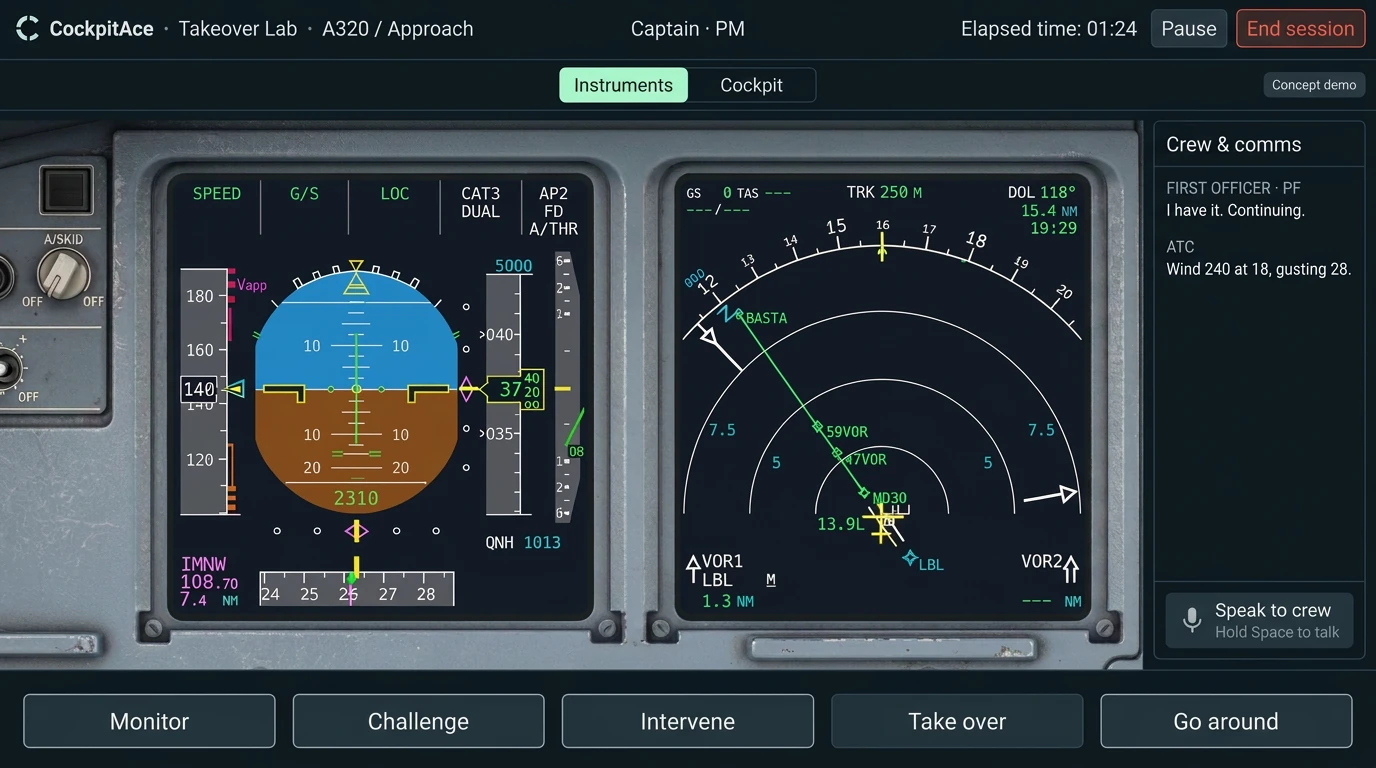
Train the decision before it becomes an emergency.
Explore the platform02 / BUILT AROUND THE DECISION
Focused scenarios bring together flight information, automation behaviour and crew interaction. Designed for deliberate practice between simulator sessions.
Start with the PFD and ND. Bring other displays and controls into view when the scenario calls for them. Notice what changes and reconsider what it means.
A callout, a question or a challenge can change what happens next. Practise making a concern clear while keeping both pilots involved.
Review the information available, your recorded actions and the crew exchange. Explore the reasoning behind a decision, not just its timestamp.
03 / TAKEOVER LAB
PLANNED MODULETaking control is one possible response. Good command considers the whole crew.
Takeover Lab is being designed to explore whether intervention is warranted, how it is communicated and what happens next. The aim is sound judgement—not a habit of taking over in every scenario.
Recognise a developing concern and practise an appropriate response. Review delayed intervention alongside the information and options available at the time.
Explore when monitoring, a clear callout or a challenge is appropriate. Unnecessary takeovers belong in the debrief too: the training should encourage trust and shared participation.
Captains set an example for first officers. We want the experience to reinforce clear communication, appropriate responsibility and constructive reflection—not pass on unhelpful cockpit habits.
The concern is acknowledged and the flight path is being corrected. A review can explore whether continued monitoring and support were appropriate, and what would have justified further intervention.
Did you give the first officer room to respond while remaining ready to act?
Illustrative reflection themes, not operational instructions. Scenario criteria need specialist review and alignment with applicable procedures.
04 / A MORE NATURAL CREW EXCHANGE
“I have control.” A spoken decision, recognised in context.
Our direction for later versions is AI recognition of spoken callouts and crew exchanges. Pilots would communicate their intent naturally, including an explicit transfer-of-control callout, rather than selecting a response button.
The objective is to understand the exchange in its scenario context, record the recognised action and bring it into the debrief. Silence would not be treated as proof that a pilot noticed, agreed or chose not to intervene.
The concept uses buttons to make early interactions explicit. Voice recognition and voice-driven scenario actions are planned; they are not available on this website.
“I have control.”
Spoken callout
Context & recognition
Recorded action
05 / ONE CONNECTED EXPERIENCE
Four planned modules connect focused practice with a review of what happened, what was recorded and what remains uncertain.
Automation surprises, conflicting information and changing conditions. Focused situations with room to reassess.
Inside the experienceMonitoring, challenge and proportionate intervention. Practise the decision and the crew interaction around it.
Explore crew judgementThe decision engine connects scenario events and recorded inputs in a timeline for review.
Explore the timelineEvidence-linked questions shaped by specialist-reviewed criteria, with AI supporting the review.
See a reflection example06 / REVIEW THE MOMENTS BETWEEN
A useful debrief asks what justified a decision, how the crew communicated and whether the response matched the situation.
A challenge input is recorded. The review can connect the concern, the information available and the other pilot’s response.
Was your concern clear, and how did you establish that it was understood?
FOR PILOTS, INSTRUCTORS & TRAINING TEAMS
We’re developing CockpitAce for individual pilots and exploring future collaboration with instructors, ATOs and airlines.
The starting point is A320 scenarios, expert review and focused practice. Scenario authoring, validated assessment and broader fleet coverage belong to the longer-term roadmap.
Where we are todayBEFORE YOUR FIRST SCENARIO
CockpitAce is in development. The screen shown here is a design concept, not a working training session. Beta dates and access arrangements have not yet been announced.
No. We want scenarios to examine whether an intervention was justified, whether its timing and form suited the situation, and how the crew worked together. Monitoring, support and a clear challenge may also be appropriate responses. Both unnecessary takeovers and delayed intervention belong in the review.
The current concept makes choices explicit with buttons. Later versions are intended to recognise spoken callouts using AI, so crew communication can drive scenario interactions. An explicit callout such as “I have control” would be interpreted in context. Voice-driven interaction still needs development and validation.
We plan to use AI to support scenario variations, recognise spoken crew exchanges and structure debriefs around recorded evidence. Defined scenario logic and aviation specialist review remain central. We do not claim that AI can infer a pilot’s thoughts or measure awareness directly.
CockpitAce is an independent supplemental training project focused on decision practice. It is not a full aircraft simulation, does not claim manufacturer endorsement or regulatory approval, and is not a replacement for approved training, operator procedures or licence requirements.
PriorityGate is the planned decision engine inside CockpitAce. It connects scenario events, explicit inputs and recorded actions in a Decision Timeline that supports the debrief.
Pricing has not been finalised. Beta arrangements and any future subscription terms will be communicated before participation.
THE NEXT CHAPTER
IN DEVELOPMENT